
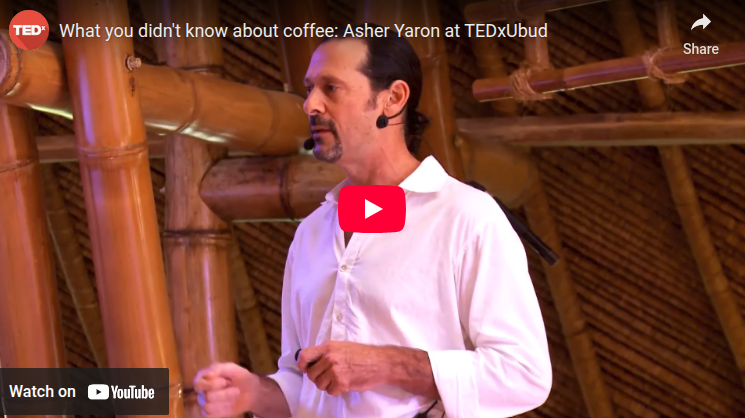

Who drank coffee this morning? You, and hundreds of millions of others like you around the world. Coffee is arguably one of the most important discoveries in the history of humankind. Today, it is the second largest traded commodity in the world, second only to crude oil, and the second most popular drink after water. It has even been credited with helping usher in the age of enlightenment.
Yet despite all this, about 95% of the roasted coffee in the world is old, stale, and effectively “dead.” Once coffee is roasted, it becomes a fresh, living food that loses its vitality and dies in about a week. This happens regardless of whether it is vacuum sealed, nitrogen flushed, or placed into any other fancy packaging. Storing roasted coffee in the refrigerator or freezer often does more harm than good.
The sacred roots of coffee
There are many legends about how coffee was first discovered, but what we do know is that its early uses held mystical and spiritual importance for many cultures. Coffee was originally prepared and consumed as part of religious ceremonies. Monks used it to stay awake during long nights of prayer and to help them reach higher states of consciousness. They were drinking coffee prepared in a very simple, fresh way.
Over time we evolved from a handful of spiritual seekers consuming this beverage to today, when hundreds of millions of people around the world drink coffee every morning. In our desire to make this special drink available to the masses, we sacrificed quality for quantity. The speaker’s mission is to recapture the mystical, powerful effects of fresh roasted coffee and make them available to everyone—what he calls the “age of enlightenment 2.0.”
From cherries to seeds
This is the branch of an arabica coffee tree grown in Bali. The cherries on this tree contain seeds inside. These so‑called “coffee beans” are actually seeds of the coffee cherries. More than 90% of the cherries have two seeds—the females—and only about 5–10% have one seed—the male. Once roasted, the two‑ and one‑seeded cherries taste different, with one being more bitter than the other, though the speaker notes that is a separate topic.
These cherries are in fact a sweet, edible fruit. After the seeds are separated from the fruit, they are dried. When properly dried, these green seeds can be stored for months or even years. But once they are roasted, the clock starts ticking. Roasted coffee has a very short lifespan and must be consumed within about a week to get the full potency and freshness.
Roasting as a transformation
Roasted coffee is a fresh food and should be treated as such. During the roasting process, more than 1,500 chemical reactions take place, transforming the seeds from their dried, green, inert state into a fresh, “alive” state that our bodies can assimilate. In this process, the seeds become a kind of pharmacological resource that can benefit the human brain and body in ways we have hardly begun to understand.
Commercial roasters often use large, expensive machines—a one‑kilo roaster costing around 6,000 dollars, a three‑kilo for about 13,000 dollars, and a five‑kilo version reaching 18,000 dollars. Yet the core technology is simple: you just need heat. Indigenous coffee cultures around the world roast their coffee in very basic pans, focusing on freshness and immediate consumption. Commercial cultures, by contrast, focus on marketing, packaging, and shelf life. One approach produces coffee that is alive, vibrant, and potent; the other produces beans that sit on shelves for weeks or months and eventually become old, stale, and dead.
Making fresh coffee accessible
Roasting coffee is a lot like making popcorn: you heat the seeds until they smoke and crack. There are two distinct “cracks,” and when the louder second crack just begins, you turn off the heat and start cooling the beans. It takes a little practice to know the right moment, but if you can make popcorn without burning it, you can roast coffee. After roasting and cooling, the beans need a short settling period—several hours, not days or weeks as some mass producers claim. Experiments have shown that espresso reaches peak potency roughly 11 hours after roasting and that the maximum freshness “cut‑off” is about seven days.
Most recent studies on coffee look at old, stale, commercially roasted beans—or at people who drink that kind of coffee. The speaker has not seen a single study that used coffee roasted just a few days before, at its peak time, or within 24 hours of roasting. From his own experience and self‑testing, he believes there are far more health benefits to fresh roasted coffee than current research has even begun to uncover.
The quest for the perfect cup
Coffee is already known to have many benefits. It is the number one source of antioxidants in the typical U.S. diet. A recent study showed that people who drink coffee tend to live longer. Still, there is much more to discover about coffee, even though it has been around for so long. The speaker has been on a 10‑year quest to find the perfect cup of coffee, without even knowing what it tasted like at the start.
At first he focused on expensive equipment—upgrading grinders and espresso machines—but saw little progress. He never realized that the roasted coffee itself made the real difference because everything he tried, with its vacuum‑sealed “space‑age” packaging, tasted the same. It was consistent, but consistently old, stale, and dead. Then one day some friends gave him fresh roasted coffee they had made at home in a hot‑air popcorn popper. The next morning, when he took his first sip, he immediately recognized that this was what he had been searching for. His life changed in that moment.
Like many home roasters, he began experimenting with common household tools—hairdryers, heat guns, hot‑air popcorn poppers, even stovetop pans that smoked out roommates. He eventually rediscovered his outdoor barbecue grill, rigged a small drum and a chicken‑rotisserie skewer turned by a motor, and began roasting at home. His early batches were uneven—some seeds very dark, some very light—but because the coffee was fresh, it was the best he had ever tasted. Encouraged, he upgraded to a larger drum and a stronger motor, eventually creating an affordable, portable, energy‑efficient roaster that produces excellent results.
A coffee roaster for the masses
The core question that drove him was: how can we have the very best, freshest coffee and still supply it to the masses? His answer was to design a coffee roaster that every café in the world can afford and access. This led to the creation of the “My Roast” roaster: a two‑kilo model (also available in five‑kilo) made entirely of stainless steel that uses only about one‑tenth the electricity of similar commercial roasters. The seeds tumble inside a drum turned by a motor at about seventy revolutions per minute, and the whole machine costs only a fraction of what other commercial roasters charge.
Because the technology is essentially simple—just applying heat—the speaker emphasizes that if you can make popcorn without burning it, you can roast coffee. He is also creating a coffee university in Bali that will teach everything “from the cherry to the cup,” including growing, harvesting, processing, roasting, and barista training. He sees this as the beginning of a new “age of coffee enlightenment.”
Fresh coffee as a superfood
The speaker calls for a revolution in the way we grow, process, and prepare our food. Nature has given us “super‑foods” that not only sustain life but also enhance and energize the life force within us, allowing us to operate more efficiently and powerfully. Fresh roasted organic arabica coffee, in his experience, enhances his ability to focus, think clearly, and create and manifest his dreams. He believes it is a powerful superfood when consumed fresh and that it can help all of humanity do the same.
At the same time, he urges people not to take his word or anyone else’s word for it. Instead, each person should try fresh roasted coffee for themselves and draw their own conclusions. Now is the time, he says, to wake up—and to smell the fresh roasted coffee.